In the Studio
Why Living with Art Matters
In Conversation With
Sir Christopher Le Brun
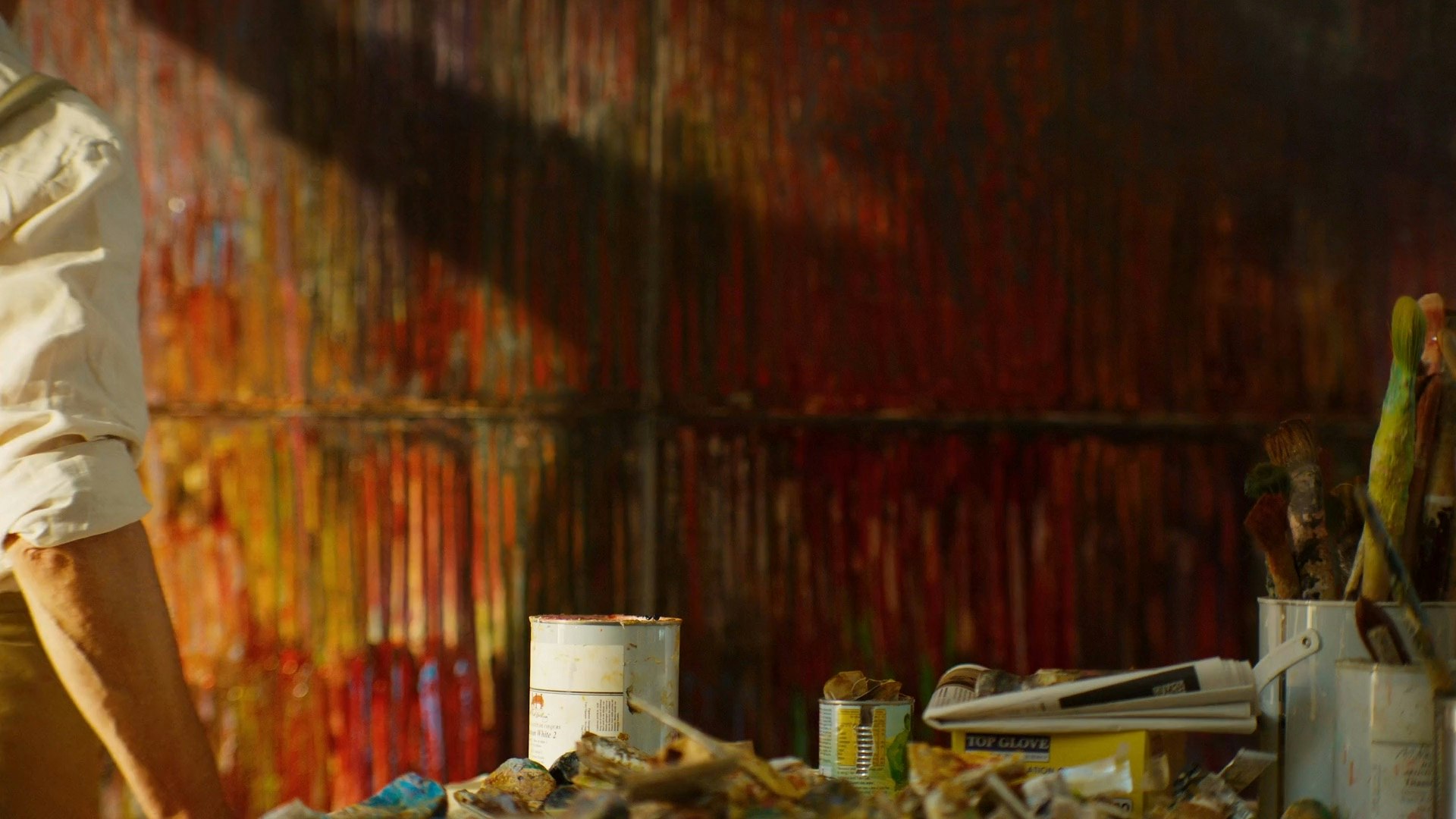
Few contemporary British artists have shaped the country’s cultural landscape as profoundly as Sir Christopher Le Brun. A painter, sculptor and former President of the Royal Academy of Arts, his works are held in major public and private collections around the world, from Europe to China and the United States. Here, Le Brun reflects on imagination, light and the experience of living with art – and why paintings should be encountered not only in galleries, but as part of everyday life at St John’s Wood Square.
Anyone who has experienced the art of Sir Christopher Le Brun in person will attest to its vitality. Emphatically contemporary, yet with a classical sensibility, there is a physicality to his work which extends far beyond the monumental scale of many of his canvases, and which amplifies his intellectual study of light, colour and space.
Art was always intended to be a cornerstone of St John’s Wood Square, and by commissioning Le Brun to create public artworks, it has in many ways found the ideal counterpart to the development’s design and architecture – disciplines which Le Brun identifies as fundamentally distinct from his own. “One of the differences between painting and design or architecture is their function,” he says. “Design and architecture are essentially practical. Painting is not exactly impractical, but it’s full of subjectivity. It doesn’t have a clear reason. Some paintings do, if you think of a portrait of a Chairman of the Board, for example. But the sort of painting I do is really about looking.”
For Le Brun, looking is not the same as observing or even seeing. It’s about discovery. “The encounter between a person and a painting appeals to the imagination and to subjectivity. That’s very unusual,” he says. “Painting provides a place for freedom of thought and freedom of imagination. I think that can be the function of painting. That’s what my paintings try to do.”
This lies at the heart of what art can bring to a residential quarter such as St John’s Wood Square, where works can become intimately entwined with the residents’ daily lives.

Sir Christopher Le Brun
with Tom Mann of St John’s Wood Square

“When you go to a gallery or museum, you’re there at a particular time, looking at particular things,” Le Brun says. “But to live with a painting – to have it on the wall in the morning, in the evening and at night – is profoundly different. Your relationship with it becomes deeper. It’s the richness, the depth, the impasto and the brushstrokes that reveal themselves through the changing day. You simply keep getting closer to the process.”
This is one of the reasons Le Brun welcomes the way the paintings at St John’s Wood Square will be seen within naturally lit interiors overlooking gardens rather than under the controlled lighting of a museum. “It is a great benefit to how they’ll be experienced,” he says. “Coming in from a garden, with the light of nature accompanying you as you see a painting, is very different.”
The paintings themselves emerge through an equally organic process. Le Brun rarely begins with a preconceived image. Instead, each canvas develops gradually, almost discovering its own identity. “What I’m looking for all the time is the best bit,” he explains. “I’m trying to avoid this word – but it’s inspiration. It’s not frequent, but it’s out there, and I’m hunting it down all the time.”
The search for that elusive moment has occupied him for decades. “I’m an arranger,” Le Brun says. “I’ve spent all my life arranging things.” Gradually, through colour, physical movement and composition, something unexpected begins to happen.
“The painting starts to pull you in. The great challenge in painting is not to push it, not to force it, but to wait until you’re aware that the painting itself is beginning to pull you towards it. At that point, you have to let it happen.” This willingness to embrace uncertainty remains at the core of his work, even after a career spanning more than half a century.
“The great challenge in painting is not to push it, not to force it, but to wait until you’re aware that the painting itself is beginning to pull you towards it.”
Sir Christopher Le Brun
“If you want to make a great painting, then there’s Titian, El Greco, Michelangelo, Raphael, Sisley, Monet... on and on. The whole history of painting is there. Every place on the canvas has been visited before. It’s like a map that’s been explored for hundreds of years,” says Le Brun. “The only way through isn’t calculation. It’s allowing your entire experience to help you discover places that perhaps haven’t been explored – arrangements of colour that have never quite existed before.”
Art, Le Brun believes, is larger than decoration, prestige or even beauty. It is about maintaining a space for imagination within everyday life. “I don’t want the world to intrude too much,” he says. “If you imagine the imagination as something inside us pushing outwards, then the world is something outside pushing in.”
In Le Brun’s view, art helps restore the balance: “What sustains us is using imagination to push back.” Occasionally, imagination pushes far enough to change the world – to create a great building, write a symphony or make a great painting. More often, it changes something more personal.
When asked what he hopes residents will feel as they encounter his paintings over the years, his answer is refreshingly simple: “If I were a chef and I’d prepared a delicious meal for you, what I’d most hope you’d feel would be joy, pleasure and satisfaction.” Painting, he believes, is not so different. “It becomes an opportunity for imagination, for dreaming and for reflection. I inevitably associate that with something rewarding. And something utterly free.”
For Le Brun, art is a vital opportunity for human feeling and touch. “The wonderful thing about paintings,” he concludes, “is that they fill a place with life.”


