Origins
The Tuscan Quarries of Carrara
In Conversation With
Giuliano D’Angiolo, CEO, Campolonghi Group
The extraordinary beauty of Carrara marble, discovered by the Romans and prized the world over, continues to shape the finest architectural projects. For St John’s Wood Square, a decades-long relationship between Executive Chairman Sir George Iacobescu and the family behind Campolonghi brought generations of expertise to the sourcing, selection and preparation of its stone.
It was the Romans who first discovered the beauty of the marble hidden above the town of Carrara in northern Tuscany’s Apuan Alps, using it for temples, sculptures and monumental architecture as an emphatic symbol of their wealth. More than 2,000 years later, the stone’s elegance and lustre remain prized worldwide. Carrara marble is a byword for excellence and prestige, used to magnificent effect over the centuries by Michelangelo in his exquisite masterpieces David and Pietà, and in architectural landmarks including the Pantheon in Rome and the US Capitol.
For over 60 years, Italian company Campolonghi has sourced some of the most prized marble from these mountains, distinguished by its rarity, purity and veining. It now owns two quarries in Carrara, both in the Torano basin: La Facciata and Cava di Sponda, where Michelangelo is thought to have chosen his own marble in the early 16th century. As well as supplying St John’s Wood Square, Campolonghi’s marble has shaped an impressive list of international landmarks including the Opera House in Oslo, the Museum of Islamic Art in Doha and the World Financial Center in New York. Giuliano D’Angiolo, CEO of Campolonghi, explains that the stone’s singular beauty, longevity and adaptability are all reasons for its appeal.


Giuliano D'Angiolo (CEO, Campolonghi), with Sir George lacobescu and Gareth Stow of St John's Wood Square at La Facciata Quarry.

The relationship between Campolonghi and St John’s Wood Square goes much deeper than the supply of marble. For decades, Executive Chairman Sir George Iacobescu has known and worked with Giuliano D’Angiolo (and before him Vando D’Angiolo, the company’s Founder and a pioneer widely regarded across the Italian stone industry as one of its most influential figures), and trusted Campolonghi’s expertise to help assemble a peerless family of stones for the development. Drawing on its own quarries and long-standing relationships with other producers, Campolonghi sourced the finest materials before cutting, preparing and treating the stone at its own facilities.
Selection was meticulous. Sir George and St John’s Wood Square CEO Gareth Stow, together with members of their design team, made repeated visits to Campolonghi to inspect and review the materials in person. Interior designers Yabu Pushelberg and Richards Stanisich also travelled to Italy as the palette for the apartments and townhouses was refined. Against the extraordinary landscape of the Apuan Alps, where immense faces of pale marble rise above Carrara and the surrounding valleys, stone was considered not simply for its individual beauty but for how its colour, veining and character would work as part of the development as a whole.
“This quarry is unique because of the pattern and purity of its marble.”
Giuliano D’Angiolo
CEO, Campolonghi Group
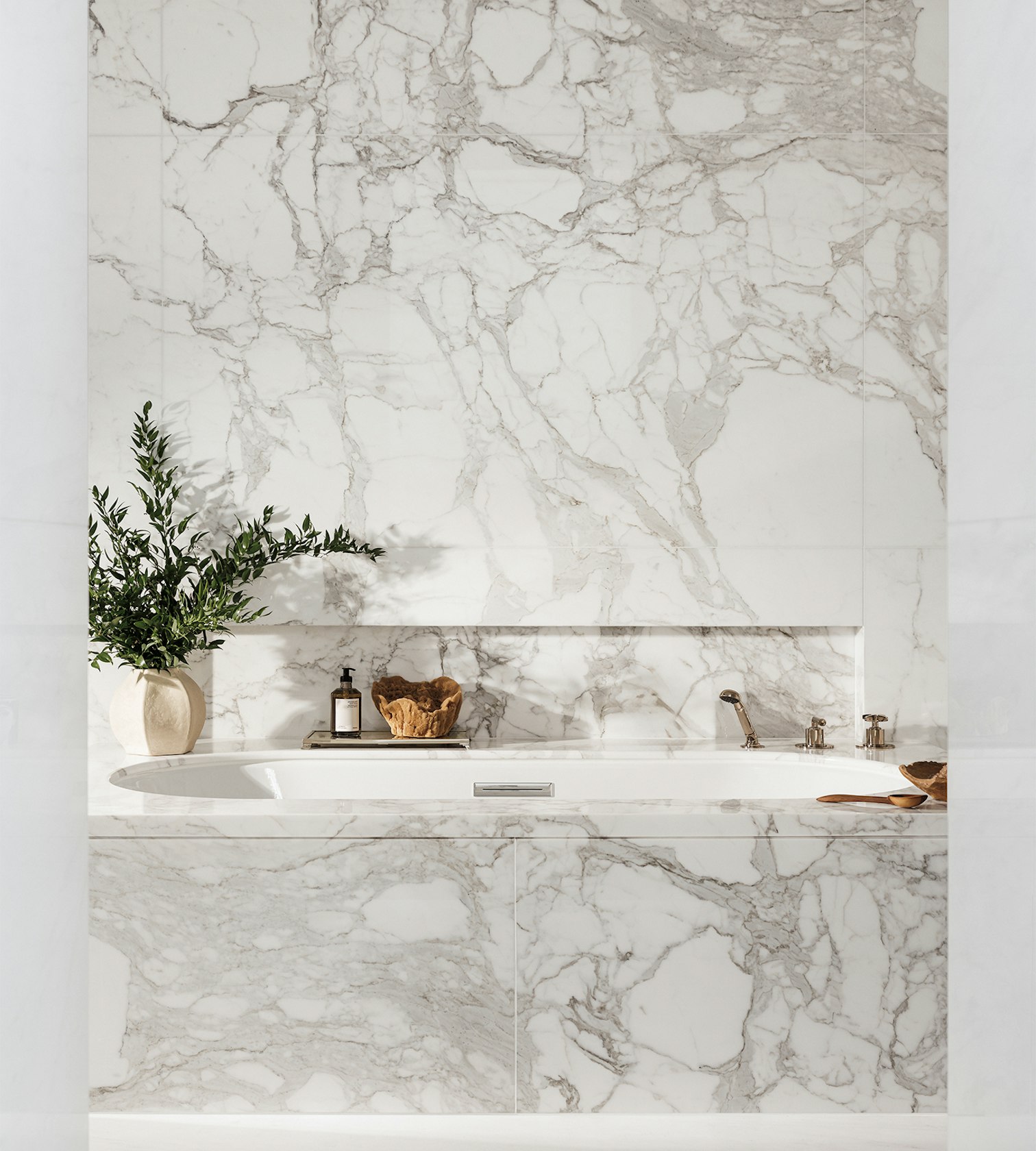
Principal Bathroom
Calacatta Oro Marble
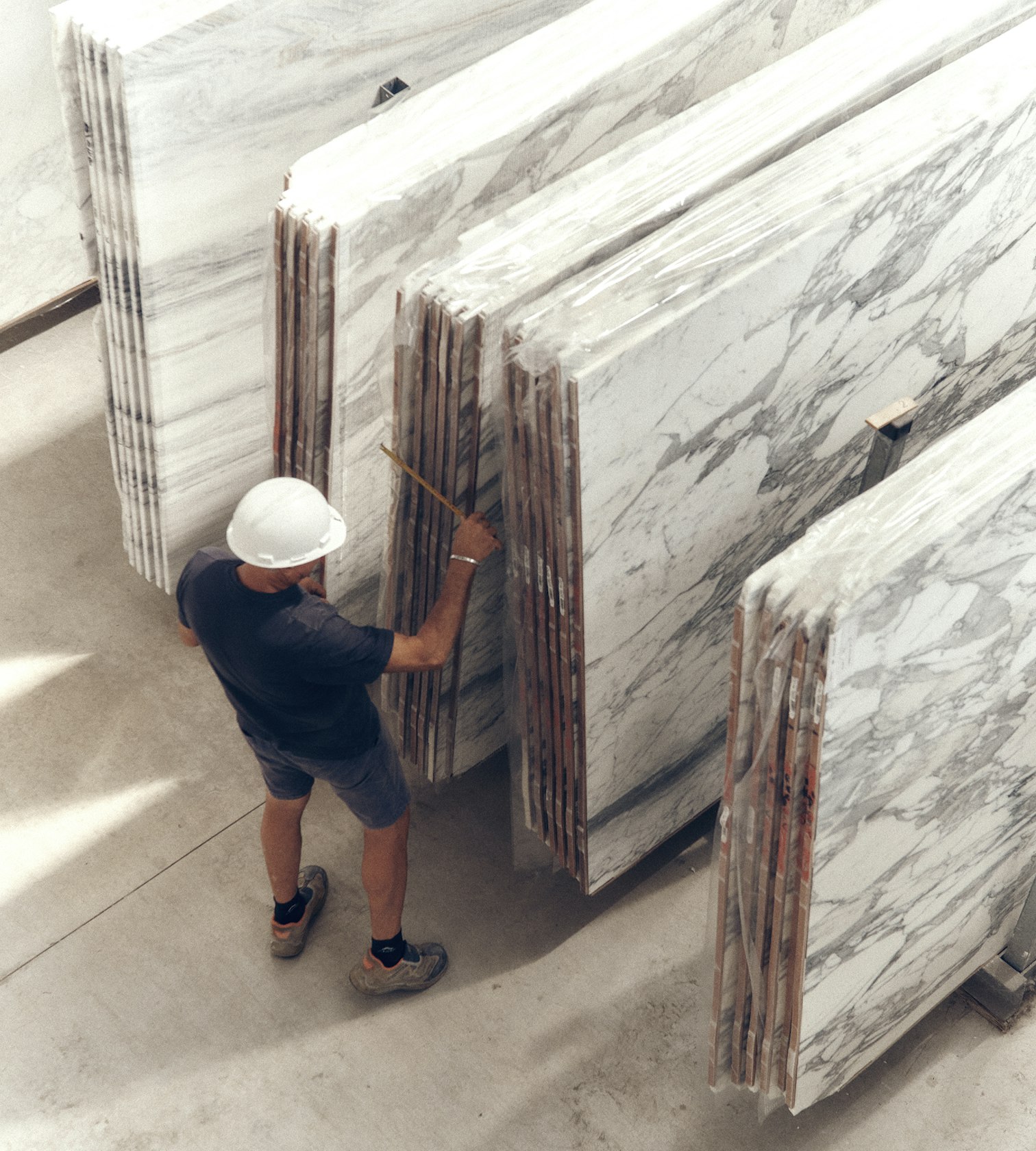
That scrutiny continued through dry-laying: the painstaking process of arranging the cut slabs before installation so that each piece can be examined alongside those surrounding it. Variations in colour and veining can be assessed and individual slabs repositioned or replaced to achieve the most harmonious composition and visual flow. It is an exacting process, but one that allows the natural variation of marble to become part of a carefully controlled whole.
“With natural stone, no two pieces will ever be identical – and that individuality is part of its beauty. But it means every slab must be studied, its veining read like a map, tracing how it moves, each piece considered in relation to the one beside it,” says Sir George. “This was never simply installation – it was craft. We reviewed the material again and again with Campolonghi and the design teams, then dry-laid it so we could see precisely how it would come together before anything was set.”
The resulting stones form an integral part of the interiors at St John’s Wood Square. Selected for durability as much as beauty, they bring richness and permanence to the apartments and townhouses by Yabu Pushelberg and Richards Stanisich. Different interior palettes include Taj Mahal quartzite stone in kitchens paired with Calacatta Oro marble in bathrooms, while others combine Mont Blanc quartzite kitchens with Taj Mahal bathrooms. The variations allow each material to express its own character while remaining part of a coherent architectural language.
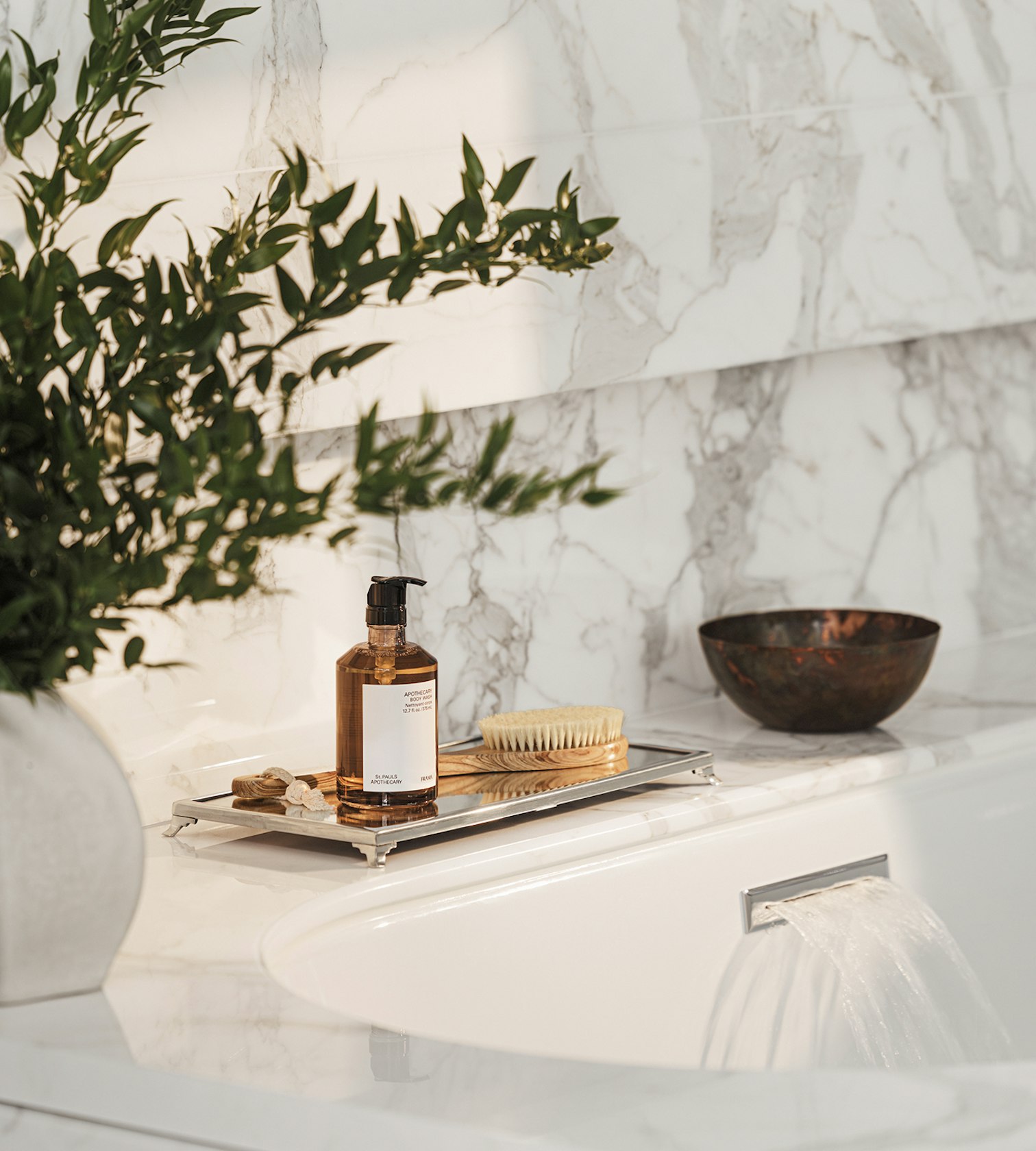
Principal Bathroom
Calacatta Oro Marble
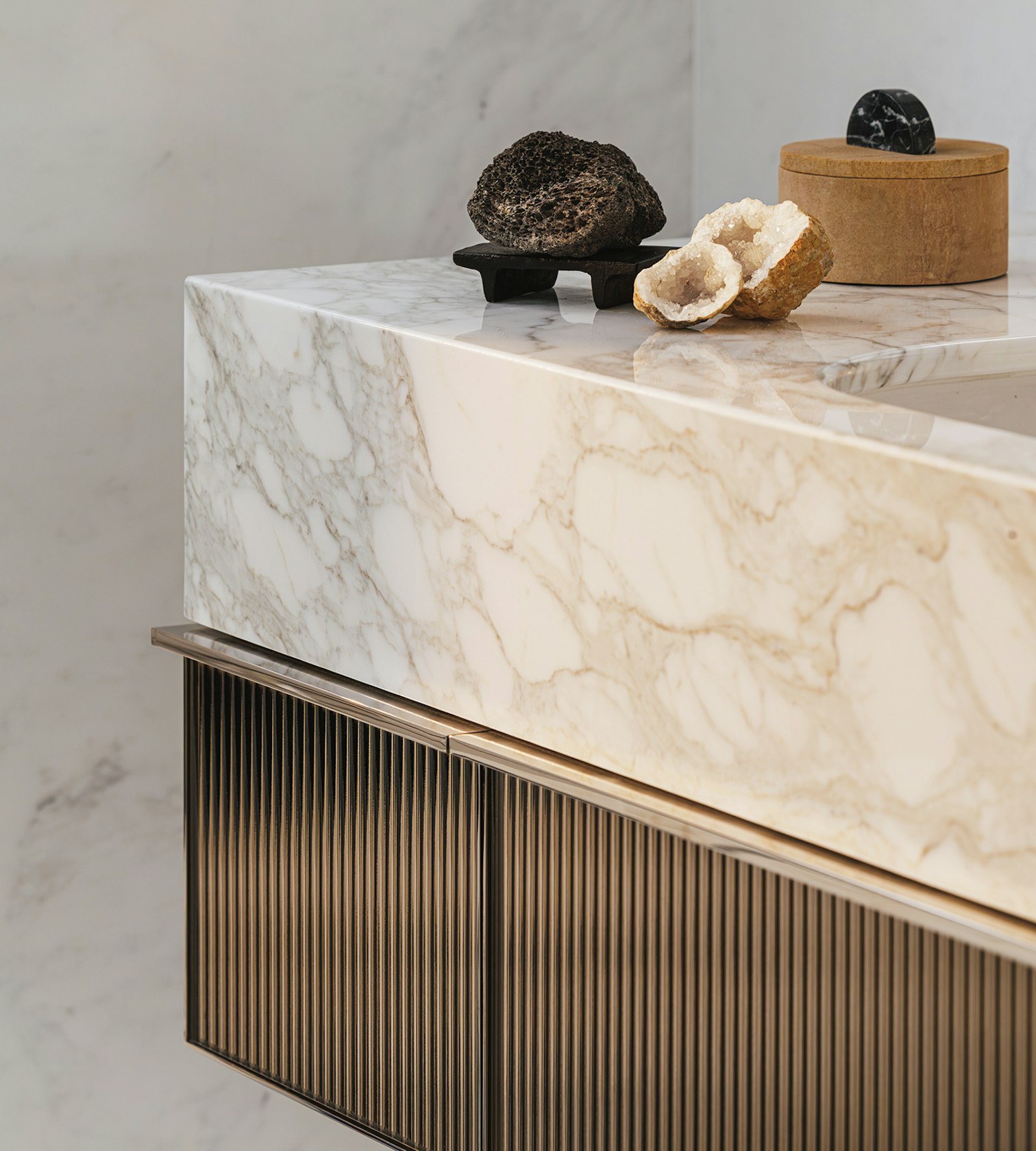
Principal Bathroom
Calacatta Oro Marble
Among the stones Campolonghi sourced for St John’s Wood Square was Carrara marble from the company’s own La Facciata quarry. “The stone from our two quarries in Carrara is exceptionally white, with soft veining that designers and architects particularly appreciate,” says D’Angiolo. “It works equally well in classical architecture and contemporary design. Whether used for columns, floors, walls, countertops or other architectural applications, it has a timeless quality that suits many different styles. That is why I believe our marble is so well suited to architecture intended to endure for generations.”
La Facciata is itself a spectacular place, spanning more than one million square feet (100,000 square metres) high in the mountains above Carrara, with dramatic views across the surrounding peaks and valleys. Around 25,000 tonnes of marble are extracted here each year. “This quarry is unique because of the pattern and purity of its marble,” says D’Angiolo. “It has been used in many major international projects. For example, during the second expansion of the Great Mosque in Mecca under King Fahd, this was the principal source of the white marble used, and it was used again during the King Abdullah expansion.”
Carving the marble from the mountain is a monumental task, one that demands precision and skilful judgement. “Giorgio Vasari (the Italian Renaissance artist who used Carrara marble in his design of Michelangelo’s tomb at Santa Croce Basilica in Florence) described quarrying as a hazard, meaning that you always had to make careful judgements about what will and won’t happen,” says D’Angiolo. “You must study the mountain, understand it and decide exactly where to quarry without damaging what remains for the future.”
The sense of continuity at Campolonghi is personal as well as material. D’Angiolo took over from his father Vando, who established the company in 1960, and he credits a lifetime spent examining the stone held in these mountains for his self-avowed passion for architecture and the finest marble. “I hope that when people walk through St John’s Wood Square, they will appreciate how classic the marble is, how it remains modern and how beautiful it will continue to look many years from now, just as it did on the very first day,” he says.
“I hope that they enjoy living with the marble as much as we enjoyed producing it for St John’s Wood Square.”


